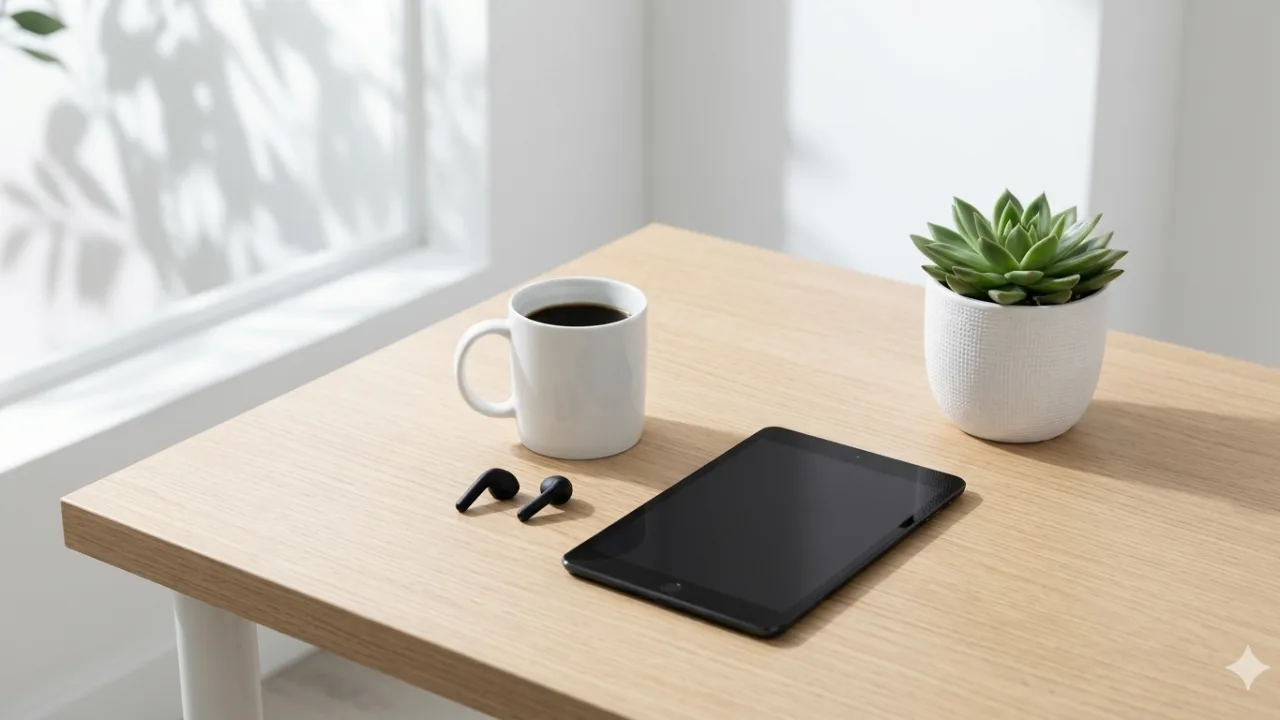
Studying isn’t limited to the time spent at your desk. For busy professionals, finding dedicated study time is incredibly difficult. That’s why leveraging the “gap moments”—when your body is active but your mind is free, like during chores, commuting, or walking—makes all the difference.
Here are three concrete tips for staying consistent with audio learning and transforming English from a chore into a pleasant “background track” of your life.
1. “Make it a habit, not a task.”
If you treat studying as a big “task,” your brain will eventually get tired. Instead, create an environment where English starts playing the moment you put on your earphones. Minimalists rely on “systems,” not just “motivation.” For example, always play English news while brewing your morning coffee.
2. “Immersion is the key.”
Don’t worry about understanding every single word. The most important thing is “immersion”—soaking yourself in the English language. By consistently listening, even as background noise, the rhythms and intonations accumulate in your brain, paying off later as “interest” in the form of improved listening skills.
【Specific Podcast Examples】
- “Global News Podcast (BBC)”: World news in refined British English. At 20–30 minutes per episode, it’s perfect for commuting or chores.
- “Ted Talks Daily”: Short speeches from global experts. You gain knowledge and language skills simultaneously.
3. “Leverage your dead time.”
Turn your “dead time”—moments when your body is busy but your mind is free—into a learning asset. I sometimes listen to English while doing simple data entry for my accounting work. The body does the work; the ears do the learning. This “multitasking” is one of the lowest-cost, highest-yield investments in your life portfolio.